
Sloperators
Have the wrong people mastered AI?


[written by a human with the hands at the end of my arms]
My go-to metaphor for using AI is the following:
If you give steroids to a Little League baseball player, they’re still a ten-year-old boy. Give them to Barry Bonds and he breaks every record in the books.
I explain it this way to illuminate the non-existent ceiling for exceptional talent but also the gap between those who’ve started to master AI and those who barely touch it.
Let’s double click on this gap. On the one hand, I’m seeing a relatively small set of people whose writing and ideas seem to fill up the internet in 2026. They are masters of leverage, experimentation and self-promotion. And there’s another group, quietly sitting in cabins somewhere, convinced good work speaks for itself. There has always been a gap here, but I think AI is making it much worse.
As a writer and maker of stuff this bothers me. Not only because I want my humble, brilliant, creative friends to flourish, but also cuz I’d prefer to live in a world comprised of carefully-built things made by people with genuine expertise. (We are, most days, living in the opposite.)
***
There’s a simple model I like for thinking about the orientation of creators in this moment, using AI:
Baseline × Leverage
I’ve been referencing and thinking about this framework for a minute, and I think it’s worth unpacking at length. Folks like Naval have written about the key forms of leverage over the years, but I don’t think we talk enough about the baseline, or the intermingling between the two.
This framework is mostly for writers and content creators, though it applies to anyone making things on the internet in 2026. Let’s get into it.
The Model: Baseline x Leverage
The Baseline is you.
Your IQ
Your taste
Your curiosity
Your knowledge
Your capacity for reflection
Some of this baseline is inherited genetically and by your upbringing. It’s the scaffolding you were born with. But most of it comes from inputs: who you’ve chosen to spend time with. Who you continue to spend time with. What you’re reading, where you’re going, what you’re asking, what you’re writing down.
Leverage is everything that amplifies you:
Internet media and distribution channels
Communities & networks you’re actively a part of
AI tools, the latest models
Education (traditional and otherwise)
Code (though I’m not covering that as much today)
Oh, and why do we multiply? Because zero on each side gives you zero.
The people who have both a high baseline and high leverage are extraordinarily rare. And extraordinarily valuable.
The Map
We can then put Baseline and Leverage on their own axes, creating four distinct archetypes.
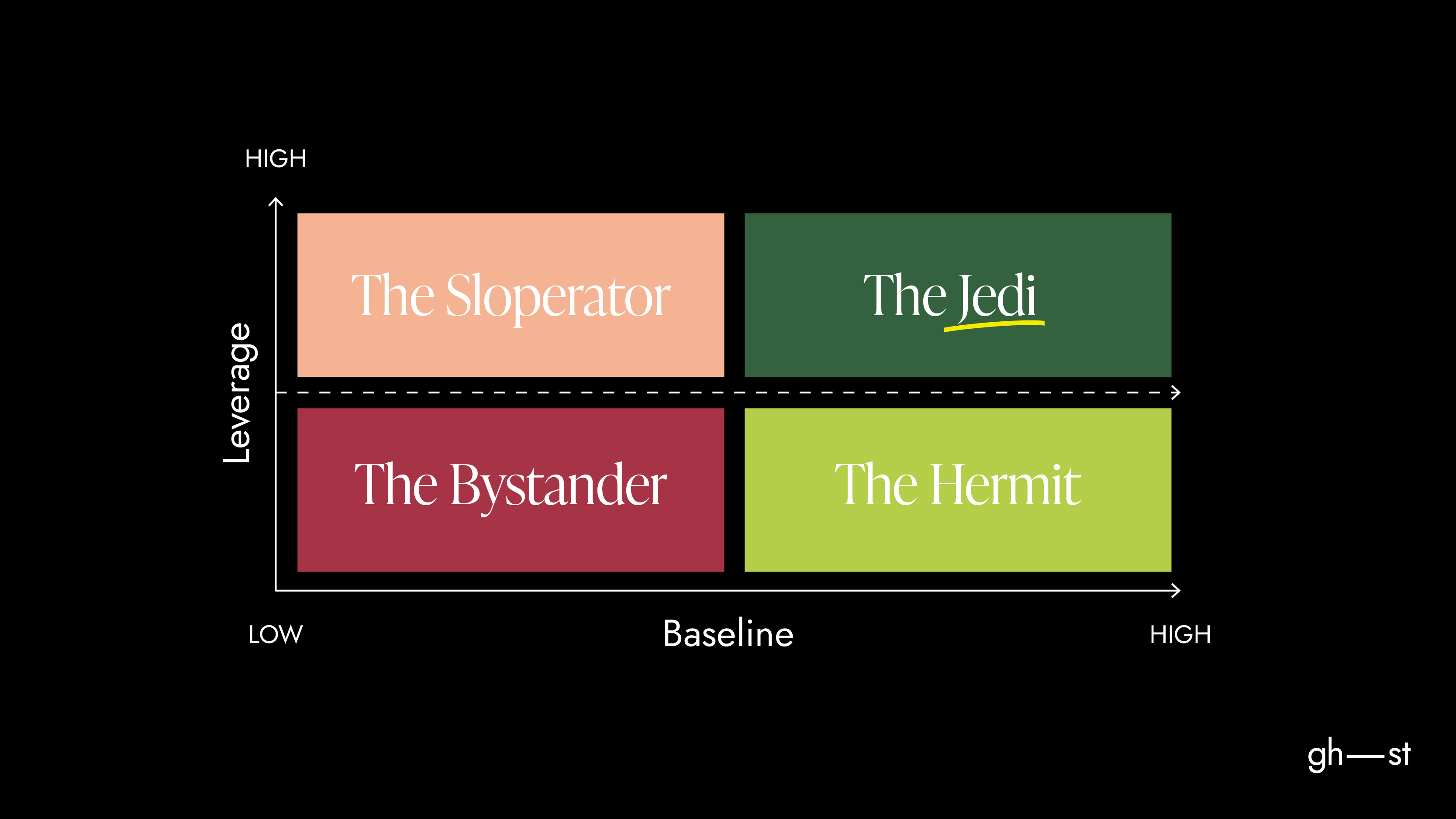
Let’s walk through each of the four and then talk about moving between them.
The Bystander (Low Baseline, Low Leverage)
People in this quadrant aren’t really building either side—doomscrollers, or genuinely happy folks connected to nature and family. Not the focus here.
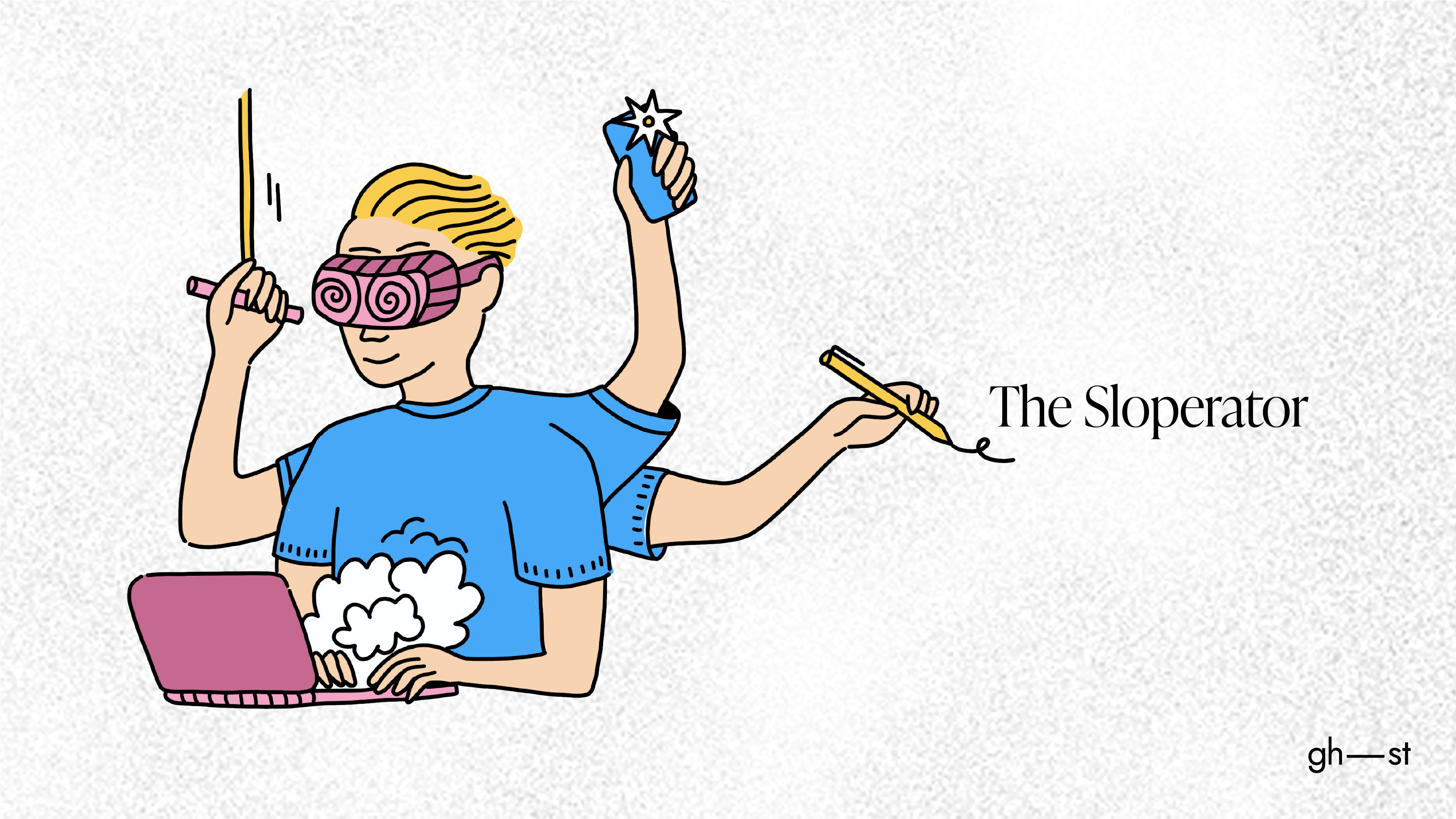
The Sloperator (High Leverage, Low Baseline)
The Sloperator has mastered the tools of leverage. They know how to optimize, how to work the algorithm, how to ship at scale. Leverage first, expertise second. They are giving the people what they want—not necessarily what’s true or earned.
I’m genuinely blown away by some of these folks. And they’ve already solved the problem of distribution! I just worry about an internet dominated by their wares.
The Hermit (High Baseline, Low Leverage)
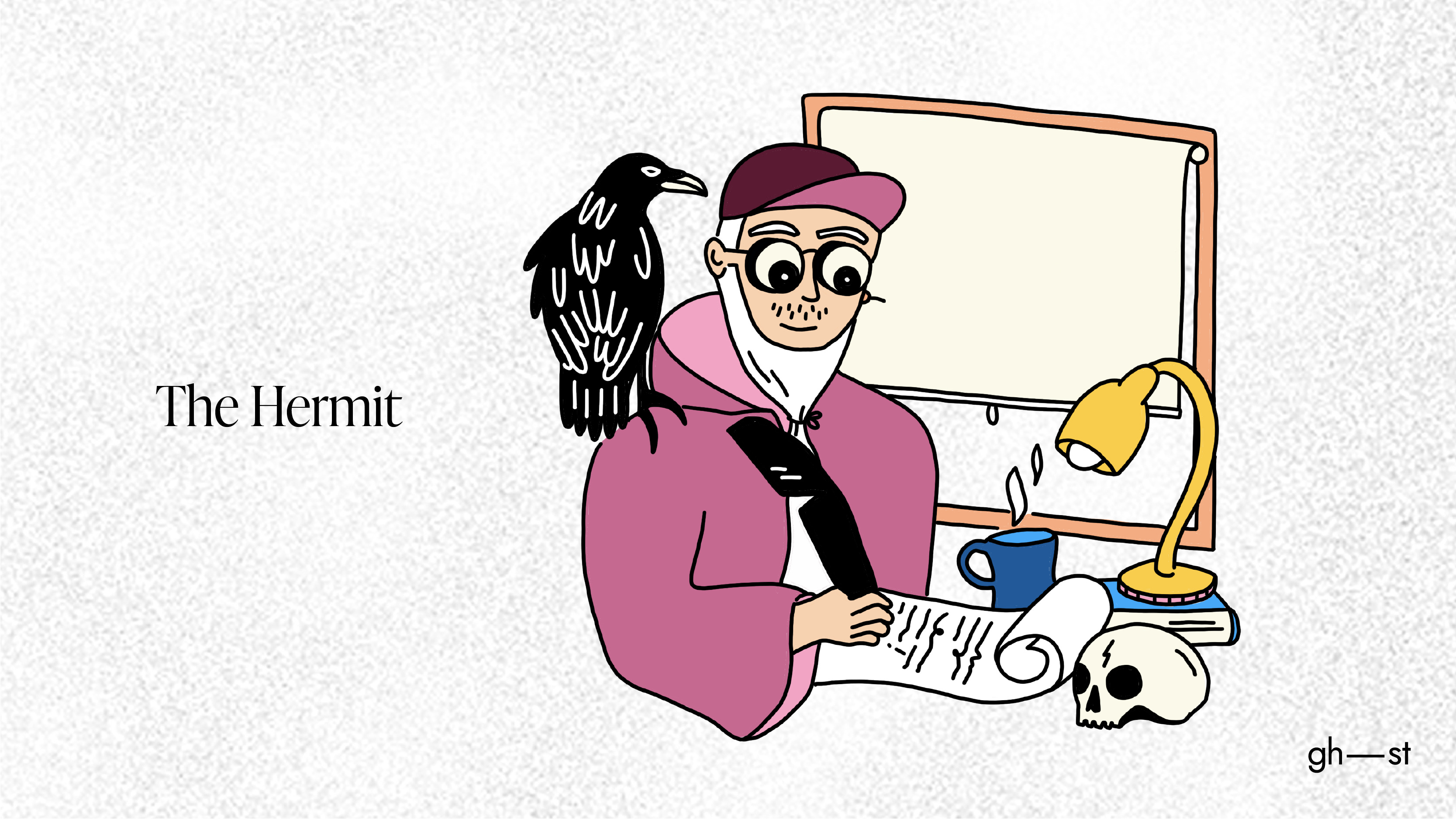
Probably the square I’m most fascinated by. And, to be fair, Hermits are usually my favorite clients. They’re scientists, academics, founders who have a decade of accumulated insight, genuinely original frameworks. They have 300 LinkedIn followers. They’re suspicious of “personal branding.” They think good work speaks for itself.
A lot of Hermits are just introverted, brilliant, humble people who lack the shamelessness or the muscles required to build and think in public. They’d rather perfect the work than promote it.
I spend more time convincing them to ship than helping them write.
Of course, Hermit phases might always be necessarily on the path to a Jedi. Maybe building baseline actually requires this Hermit phase—time away from the algorithm, away from the performance of ideas, just wrestling with problems until you develop genuine insight.
(Adjusts glasses on bridge of nose—you know, Obi-Wan was a hermit at the beginning of A New Hope…)
The question for Hermits is: when do you come out of the cabin? And how?
The Jedi (High Baseline, High Leverage)
This group is exceedingly rare. But I think they’ll end up dominating the internet of 2027 and beyond. They’ve accumulated genuine expertise, developed a point of view that could only have come from their specific life, and figured out how to be seen without going hollow in the process.
Their leverage serves their substance, not the other way around. (Will Manidis comes to mind.)
Not the loudest voices or the most prolific posters—the ones whose ideas travel because they’re brilliant and original, not because they were… engineered to travel.
Moving Between Zones
Building Your Baseline
Baseline compounds slower than leverage. That’s what makes it valuable.
If you’re a Sloperator, building your baseline will improve the quality of your writing, your thinking, your output, your originality. You’ll create work that lasts instead of work that just performs.
Spend time with yourself and your own thinking
Study work that intimidates you
Keep a personal canon and keep returning to it
Surround yourself with people who challenge you
Get away from screens! Add friction back to where it’s disappeared
Use AI to expand your range, not replace your judgment
Put yourself in rooms where you’re the dumbest person
Building Leverage
If you’re a Hermit, building leverage means your ideas will finally reach the people who need them. You’ll stop watching less talented people get credit for work you could have done better.
Master the tools. Pick one and actually learn it. Not five tools badly, one deeply. Use it to accelerate research, test arguments, break down complex work. The tool expands your range when you keep the judgment.
Pick your platform. X, Substack, TikTok even. Choose one and ship there consistently for six months.
Build distribution before you need it. Share work in group chats, comment genuinely on other people’s posts, send pieces to people who’d care with a note about why.
Get comfortable shipping imperfect work. Platforms are conversations, not monuments. Test ideas publicly, refine them privately, publish the good version later.
Before we go: Why does any of this matter?
I think huge chunks of the internet are becoming unreadable. And it’s because a lot of the people who’ve mastered AI content have nothing to say, and the people with something to say won’t touch it. We’re optimizing for the wrong variable.
The way out of this maze is to teach and empower Hermits to grab the mic, and to help Sloperators raise their baseline.
The Sloperators will probably win in the short term. They’re tapped into the algorithms, they understand the game, they’ll get more views and more followers.
But the people who actually shape us and how we think about problems, who build work that compounds over years… they have a higher baseline. My hope is that substance wins in the long run, even if leverage wins the week.
Anyhow! I hope this model is useful for you. Until next time. -A
Great post, Adam. Rings true to me. Are you on TikTok yet??
Love the framework. It feels like humanity is stuck in identifying who is who.
Now, audience is overwhelmed with 10x more slop and need to define & look harder for an actual signal, since it is too noisy nowadays.